
10 Fascinating Elephant Facts for Kids (Free Printable Included)
This post contains affiliate links marked with ✦ – this means I may earn a small commission if you purchase through my links, at no extra cost to you. I only ever recommend products our family genuinely uses and loves. Thank you for supporting Kate on Safari.
If you’re looking for elephant facts for kids that go beyond the basics – you’re in exactly the right place.
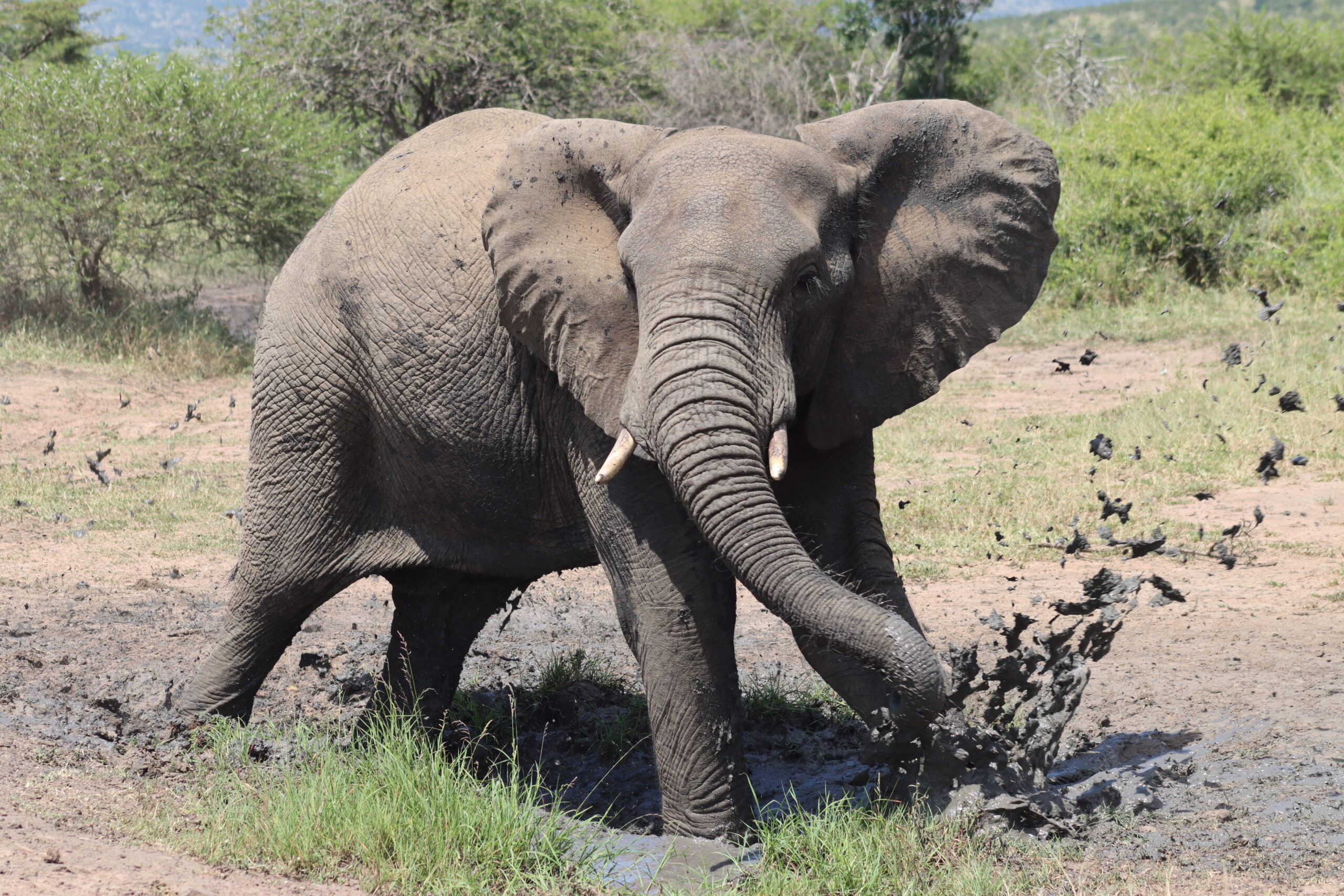
I still remember the first time my eldest daughter saw a wild elephant.
We were in a game reserve not far from our home in KwaZulu-Natal, South Africa, and a young bull elephant walked out of the bush not twenty metres from our vehicle. Whilst I am whispering to everyone to be as quiet and still as possible, V went completely silent. Not frightened – just utterly still, the way children go when something genuinely magnificent presents itself.
That silence was worth more than any classroom lesson I could ever give her.
Elephants do that to children. They stop them in their tracks. And when the questions come afterwards – and they always come – those questions are the best kind. The kind that open doors.
So here are 10 elephant facts for kids that will do exactly that. Facts that don’t just inform, they astonish. The kind your children will want to tell everyone they know.
If you’re planning a trip, our educational safari for kids guide covers everything families need to know.
What You’ll Find in This Post
- 10 fascinating elephant facts for kids aged 4–12,
- Simple explanations that make each fact meaningful,
- A free printable Safari Animal Mini Pack to bring the learning to life,
- Recommended books and resources for going deeper.
🐘 Fact 1: Elephants can recognise themselves in mirrors.
Only a handful of animals on earth can look in a mirror and understand that the reflection is themselves rather than another animal. This elephant fact for kids never fails to astonish – elephants can recognise themselves in mirrors. Humans, great apes, dolphins, and magpies are also in this extraordinary club.
Scientists call this self-awareness, and it’s considered one of the markers of higher intelligence. When researchers placed a large mirror in front of elephants, they used it to examine parts of their own bodies they couldn’t normally see – touching markings on their foreheads while watching the reflection.
Talk about it with your child: Can you think of any other animals that might recognise themselves in a mirror? Why do you think most animals can’t?
🐘 Fact 2: A baby elephant is raised by the whole herd.
When a baby elephant is born, its mother doesn’t raise it alone. Every female in the herd – grandmothers, aunts, older sisters – takes an active role in caring for the calf. These helper elephants are called allomothers and they babysit, protect, comfort, and teach the baby alongside its mother.
This means an elephant calf grows up surrounded by a village of experienced, caring females. It’s one of the most tender things in the natural world. The true meaning of it takes a village.
Talk about it with your child: Who are the people in your life who help look after you, like an elephant herd looks after a calf?
🐘 Fact 3: Elephants communicate through the ground.
Elephants make sounds we can hear – rumbles, trumpets, roars. But they also communicate in ways we can’t hear at all. They produce low-frequency vibrations that travel through the earth itself, felt by other elephants through the sensitive skin on the soles of their feet.
These seismic signals can travel several kilometres through the ground, allowing elephants to communicate with each other across distances far beyond what their voices could carry.
Talk about it with your child: Put your hand flat on the ground outside. Can you feel any vibrations? What do you think the earth might be carrying that we can’t hear?
🐘 Fact 4: Elephants grieve their dead.
This is the elephant fact for kids that moves adults as much as children.
When an elephant dies, members of the herd gather around the body. They touch the bones gently with their trunks, stand quietly, and sometimes return to the same spot years later. Researchers have documented elephants showing what can only be described as mourning – standing still for long periods, appearing subdued, returning repeatedly to places where loved ones died.
Talk about it with your child: What does this tell us about how elephants feel? Do you think animals experience sadness?
🐘 Fact 5: An elephant eats for 16 hours a day.
An adult elephant needs up to 150 kilograms of food every single day. To find it, they spend around 16 hours eating – roughly two thirds of their entire day. Grass, leaves, bark, fruit, and roots all feature on the menu.
This constant eating also shapes the landscape. Elephants knock down trees, dig waterholes, and create clearings that other animals depend on. They are what scientists call a keystone species – remove them and entire ecosystems change.
Talk about it with your child: If you had to eat for 16 hours a day, what would you choose to eat? What do you think would happen to the bush if there were no elephants?
🐘 Fact 6: Elephant trunks are extraordinarily powerful and sensitive.
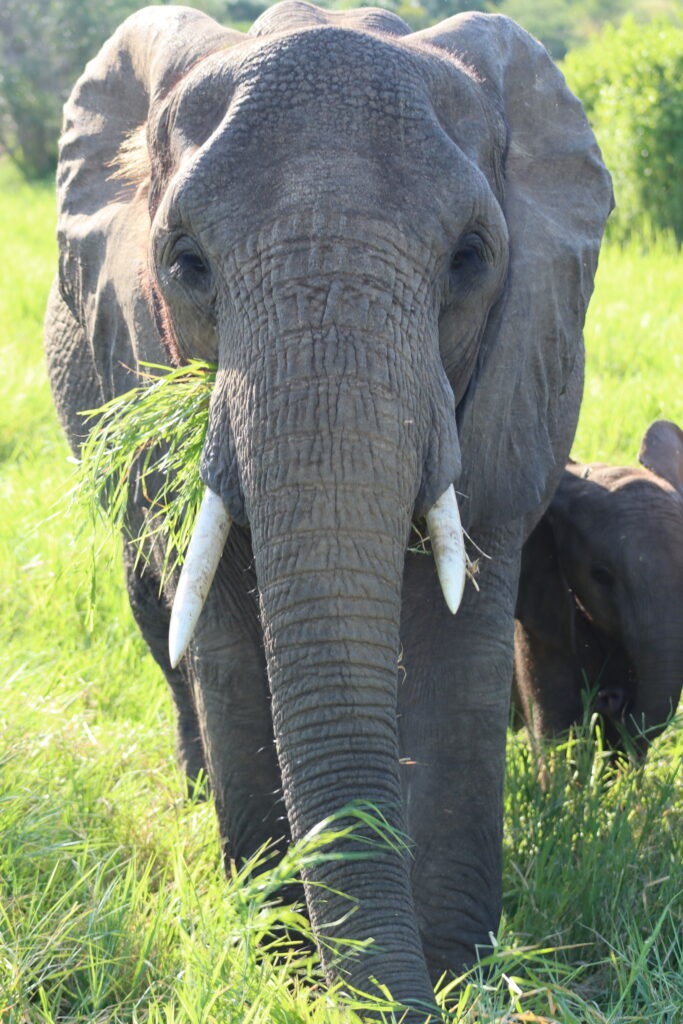
An elephant’s trunk contains around 40,000 muscles – for comparison, the entire human body has around 600. This makes it both incredibly powerful and extraordinarily sensitive.
With its trunk an elephant can uproot a tree, carry a 300 kilogram log, and also pick up a single blade of grass. It can snorkel underwater, spray water over its back to cool down, and detect smells from up to 19 kilometres away.
Talk about it with your child: What would you do if you had a trunk? Can you think of five things it would be useful for?
🐘 Fact 7: Elephants have a dominant tusk – just like humans are left or right handed.
Elephants regularly use both tusks but tend to favour one over the other – exactly the way humans are left or right handed. The dominant tusk is called the master tusk and you can usually spot it because it’s more worn down than the other one from constant use.
Talk about it with your child: Are you left or right handed? Look carefully at pictures of elephants – can you spot which tusk looks more worn?
🐘 Fact 8: Baby elephants suck their trunks for comfort
Here’s an elephant fact for kids that always makes children giggle.
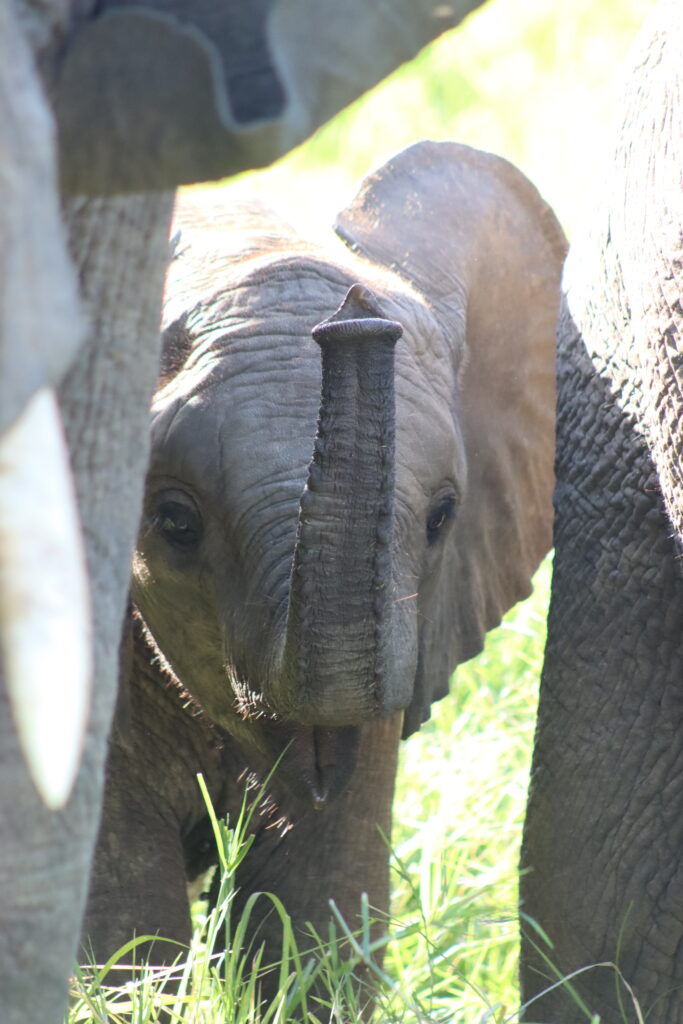
Just as human babies suck their thumbs, baby elephants suck their trunks when they need comfort or reassurance. It’s a self-soothing behaviour that appears in the first weeks of life and gradually fades as the calf grows older and gains confidence.
Talk about it with your child: What do you do when you need comfort? What do you think makes a baby elephant feel safe?

🐘 Fact 9: Elephants can swim – and they love it.
Elephants are strong, enthusiastic swimmers. They use their trunks as natural snorkels when crossing deep rivers, holding them above the water to breathe. Young calves who can’t yet touch the bottom have been observed being helped and supported by older elephants in the herd as they cross.
In hot weather elephants actively seek out water not just to drink but to swim and wallow in — it cools them down and also helps protect their skin from insects and sunburn.
Talk about it with your child: How do you cool down on a hot day? What other animals do you know that love to swim?
🐘 Fact 10: Elephants never forget – and science agrees
This final elephant fact for kids turns out to be grounded in real science.
The phrase “an elephant never forgets” turns out to be grounded in real science. Elephants have remarkable long-term memories – they can remember the faces and voices of individual humans and animals they haven’t encountered for decades.
Matriarch elephants – the oldest females who lead the herd – carry mental maps of their entire range, remembering the locations of water sources and food that haven’t been visited in years. During droughts this memory can save the entire herd.
Talk about it with your child: What is the oldest memory you have? What do you think it would be like to remember everything you’ve ever seen or heard?
Share these elephant facts for kids with someone who loves animals and see what questions they ask.
Bring these facts to life – free printable
Bring these elephant facts for kids to life with our free printable – Safari Animal Mini Pack which includes a beautifully designed elephant fact card – perfect for printing at home, sticking on the wall, or taking on your next nature walk.
GET YOUR FREE SAFARI ANIMAL MINI PACK
It also includes fact cards for the lion and the giraffe – because once you start learning about Africa’s wild world, it’s very hard to stop.
Recommended Books About Elephants for Kids
If your child has loved these elephant facts for kids, take a look at our family favourites – affiliate links marked with ✦
✦ The Elephant Whisperer for Young Adults by Lawrence Anthony – the true story of a man who saved a herd of wild elephants in KwaZulu-Natal. Genuinely moving and deeply relevant to where we live.
✦ Elephant Amazing Animals by DK – beautiful photographs, child-friendly facts, perfect for ages 6–10.
✦ The Last Elephants edited by Don Pinnock – for older children and parents who want to understand elephant conservation more deeply.
For more on our favourite wildlife reads, see our African wildlife books for children guide.
Want More Wild Learning?
Every week I send one free nature activity, wildlife story, or wild learning idea to families just like yours – straight from our life here in KwaZulu-Natal, South Africa.
Let Africa teach your children what the world is made of. 🌍
Written by Katie Wormald – co-owner of The Little Bush Baby Company and founder of Kate on Safari. Katie lives in KwaZulu-Natal, South Africa with her husband and three children, raising her family close to the wild.


2 Comments